The customer was evaluating technical solutions for a new automotive lithium-ion battery management system. Their two major design objectives were improving circuit efficiency and reducing the size and weight of the measurement and control systems to improve driving range and lower system costs. As this application is still relatively new, there are rapidly evolving innovations that need to be evaluated and potentially included in next-generation designs.
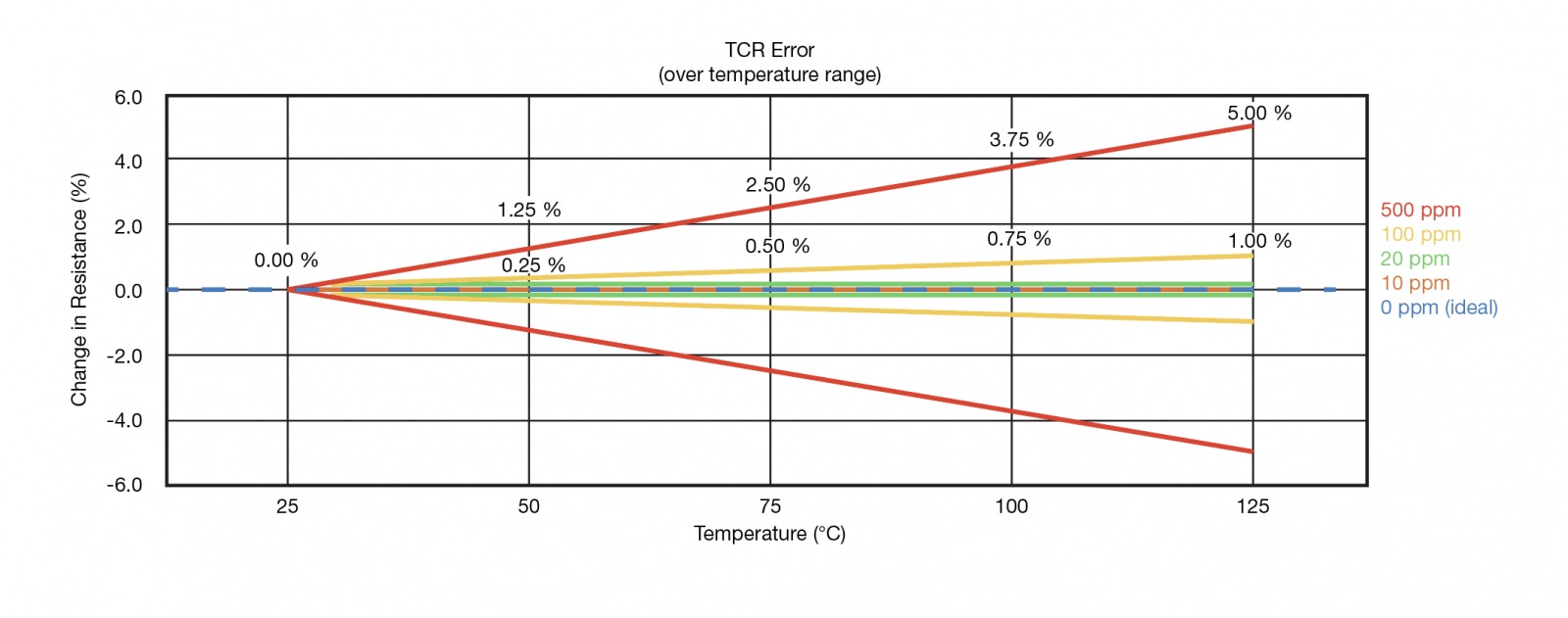
Typically, lithium-ion batteries operate between –30 °C and +85 °C, and accurate current measurements are critical in ensuring the correct state of charge and battery health. These measurements are usually performed using very low ohmic (typically µΩ) current shunt resistors. The specific TCR of the current shunt resistor is a reversible change of resistance as a function of temperature, and is present in all resistors. This change is non-linear, depending on the alloy materials and construction, and the actual TCR ppm varies across this wide temperature range. Taking TCR into account requires characterization across the operating temperature range to ensure accurate current measurements are recorded. In addition, temperature compensation software and circuitry are required to adjust the actual measured results for the purpose of controlling the circuit for charging and discharging.

Vishay has patented a new mechanical construction for current shunt resistors that provides current shade via an electrical obstruction that significantly reduces TCR across the operating temperature range. This “flattening” of the TCR curve down to 10 ppm/°C means real data can be recorded and used by the control circuit without requiring adjustments. The power coefficient of resistance (PCR) of the current shunt resistor is also minimized, as the effect of self-heating is significantly reduced.
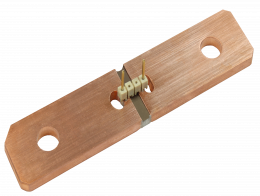
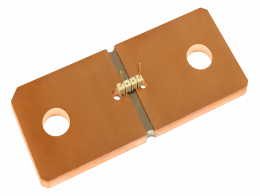
Designing with a Vishay custom shunt resistor featuring a patented TCR construction enabled the designer to reduce the overall PCB area, component acquisition cost, and also the weight of the control circuit by eliminating the need for costly TCR compensation circuitry. Consequently, it also reduced the design time — as characterization of the circuit was no longer necessary — and also system response time by removing the need for software adjustments to the actual system current measurements during operation.
Removing this circuitry also avoids introducing errors and inaccuracies caused by the analog to digital conversion and the tolerances of the thermistor during temperature measurement, as well as any errors in the quadratic equation / mathematical models that are subsequently applied to this data. In addition, evolutionary developments for higher voltage, next-generation designs become easier and faster without the need for characterization and TCR compensation.
Challenge
The customer approached Vishay when their existing panel potentiometer supplier discontinued production of a part used on an established and popular piece of equipment. To avoid a costly redesign, an existing panel potentiometer needed to be adapted to meet the customer’s electrical requirements. It would also have to fit the control panel insertion / retention envelope and existing markings, in addition to the PCB assembly attachment system.

This is our general contact form. If you have more specific questions or needs please select from the options below.

Challenge
A customer’s prototype design was developed using the Vishay RH / NH (non-inductive) series of aluminum-housed, chassis-mounted wirewound resistors. These high power resistors are typically used in high power applications that see high pulse energy, especially at start-up. The electrical performance of the RH device met the design parameters and the PCB footprint, size, and weight requirements of the circuit. However, in application testing, the design had experienced arcing on the resistor terminal that had to be mitigated by increasing the creepage distance in the resistor. The fastest and easiest way to achieve this was to find a way to modify the existing resistor series, as this solution would not require any other changes, which are time-consuming and expensive at this stage of a design.