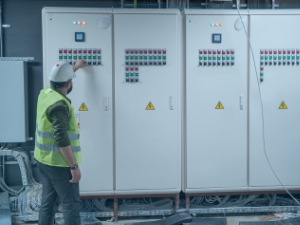
Our customer was a manufacturer of hospital ventilators at the outset of the COVID-19 pandemic. Demand for these ventilators increased dramatically as the number of cases rose sharply and the medical industry attempted to respond in a very short timeframe.
One of our customer’s existing resistor suppliers was temporarily shut down and unable to manufacture the parts required. The case sizes, resistance values, and power ratings of the devices used were not common values, and were thus unavailable in standard series from other manufacturers.
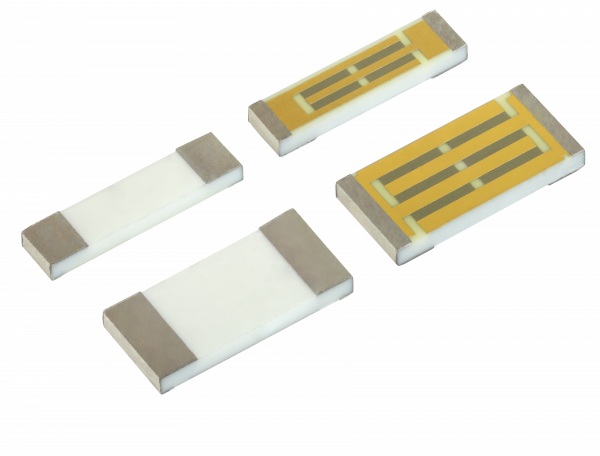
To avoid a costly and time-consuming redesign and re-approval process, the Vishay design team was tasked with creating a 1 W resistor in the 2506 case size with two different resistance values below 10 Ω.

The Vishay thin film PHP series was electrically similar to our customer’s previous solution in terms of material specifications, and therefore some areas of electrical performance. It was already available in the 2512 case size, and was rated at 2.5 W with a resistance range from 10 Ω to 30 kΩ. Mechanically altering the substrate and reducing the case size width by 50% immediately met the 2506 case size requirement, and the part could easily achieve a power rating of 1 W.
As mentioned, the resistance values required were outside the standard PHP range. Sputtering additional material onto the substrate reduced the resistance value and tests were quickly carried out to establish the process required to achieve the required low ohmic values. All of the above customization was performed in under three weeks — an extraordinarily short timeframe.
Our customer was able to restart production of their ventilator product and begin shipments to hospitals, saving the lives of COVID-19 patients.

Challenge
Our customer was designing a pulsed application that required a high power 1000 W resistor at high frequencies. Frequent cycling of high power can cause the different materials in the resistor to expand and contract rapidly at different rates. As a result, this thermal mismatch in the coefficient of thermal expansion (CTE) of the various materials can have very destructive effects, including device / system failure. Standard flanged resistors in these types of applications typically fail after 600 cycles to 1000 cycles, while the customer in this application required significantly higher reliability for the design to be successful.

This is our general contact form. If you have more specific questions or needs please select from the options below.

Challenge
The customer was evaluating technical solutions for a new automotive lithium-ion battery management system. Their two major design objectives were improving circuit efficiency and reducing the size and weight of the measurement and control systems to improve driving range and lower system costs. As this application is still relatively new, there are rapidly evolving innovations that need to be evaluated and potentially included in next-generation designs. Typically, lithium-ion batteries operate between –30 °C and +85 °C, and accurate current measurements are critical in ensuring the correct state of charge and battery health. These measurements are usually performed using very low ohmic (typically µΩ) current shunt resistors. The specific TCR of the current shunt resistor is a reversible change of resistance as a function of temperature, and is present in all resistors. This change is non-linear, depending on the alloy materials and construction, and the actual TCR ppm varies across this wide temperature range. Taking TCR into account requires characterization across the operating temperature range to ensure accurate current measurements are recorded. In addition, temperature compensation software and circuitry are required to adjust the actual measured results for the purpose of controlling the circuit for charging and discharging.